Resistance in Greek national memory
Cartes Postales from GreeceResistance in Greek national memory is not confined to accounts of past battles: it is renewed through a national parade, the meanings attached to a flag, and stories told by people who treat inherited history as part of their own lives. The narration connects the Greek struggle for liberation from Ottoman rule with the ancient stand at Thermopylae and with resistance to German occupation, while showing how those memories shape both public ceremony and personal encounters.
A commemorative day
The scene in Thessaloniki takes place on 25 March, a warm spring day when the narrator finds flags across balconies, public buildings, roads, and squares. Thousands of schoolchildren, soldiers, and people in regional costume march before the crowd. The parade marks Greek Independence Day, commemorating liberation from Ottoman rule, which had lasted nearly four centuries. The narration contrasts that period with the more recent German occupation, which it describes as lasting three years. The two occupations are not treated as identical episodes; together, however, they make resistance and the recovery of national freedom recurring concerns in the account.
The date also coincides with the Feast of the Annunciation, the Christian feast recalling the announcement to Mary that she would have a child. An elderly man beside the narrator links the religious observance to the beginning of the uprising. In his telling, a bishop chose the feast day for the Greeks to rise and fight, making the struggle against Ottoman rule a holy war. The alignment of liberation commemoration and religious celebration gives the parade a double significance: the date carries both national and sacred meaning. The man speaks of the Greeks as having been greatly outnumbered, but insists that divine support mattered more than the imbalance. His account presents faith not as a separate subject from political history but as part of the way that history is remembered.
The flag as a compact history
The old man raises a small Greek flag as he recounts the struggle. Its appearance is more than decorative in the scene: people around him begin listening, and a young woman holding her child nods along. The flag makes an inherited account visible in the present crowd, while the speaker’s gestures turn a public parade into an occasion for narration. He describes the Greeks as having preserved their language, traditions, and religion despite centuries of Ottoman rule; in this telling, continuity itself is a form of resistance.
A second scene makes the flag’s symbolism explicit through Evangelia, an older woman watching another parade. Decades earlier, she had been chosen as a flag-bearer because she was top of her class. She relives that moment each year and awaits her granddaughter, who bears her name and is carrying the flag in the current parade. The family’s repeated participation links school achievement and public honor across generations. As teenage marchers pass, Evangelia moves her small flag back and forth in an effort to match their rhythm, joining the present ceremony through a modest, repeated gesture.
Evangelia considers the flag’s blue-and-white design and its nine horizontal stripes. Each stripe recalls one of the nine syllables in the rallying cry used to drive out the Turks: Freedom or Death. The design therefore condenses a political claim into an object that can be carried, displayed, and passed through a family’s experience of the parade. Evangelia, like the elderly storyteller in Thessaloniki, believes God supported the struggle and connects that belief to the end of Ottoman oppression. The flag embodies the motto for her, joining the memory of liberation to a contemporary public ritual.
Stories passed between generations
The parade’s historical meaning is conveyed not only by formal ceremony but by speakers who find an audience in it. The elderly man in Thessaloniki is with his family, yet the narrator recognizes that he welcomes a new listener because his wife and daughter have heard the stories many times. He recounts the past with the urgency of someone for whom the battle remains emotionally present. His family’s familiarity does not end the telling; the parade supplies a public setting in which the story can be repeated to a stranger and heard by other onlookers.
The encounter also places historical narration within ordinary hospitality. After the march, the man’s daughter invites the narrator to join her family for lunch, despite the narrator being a stranger. The invitation follows the public exchange and offers a quieter setting for another account of love and war. The transition from the crowded street to a family meal shows how the national past travels through personal conversation as well as official commemoration. The old man’s story is not presented as detached exposition: it is bound to a family gathering, a local celebration, and the attention of whoever is willing to listen.
Evangelia’s memory offers a different form of transmission. Rather than recounting a battle, she returns each year to her own earlier place in the parade and watches her granddaughter take up a corresponding role. Her pride attaches the national flag to a specific family succession, while the repeated annual ceremony allows personal remembrance and national symbolism to occupy the same moment. In these scenes, memory persists through retelling, watching, and participation—not only through knowledge of military events.
From ancient defiance to modern resistance
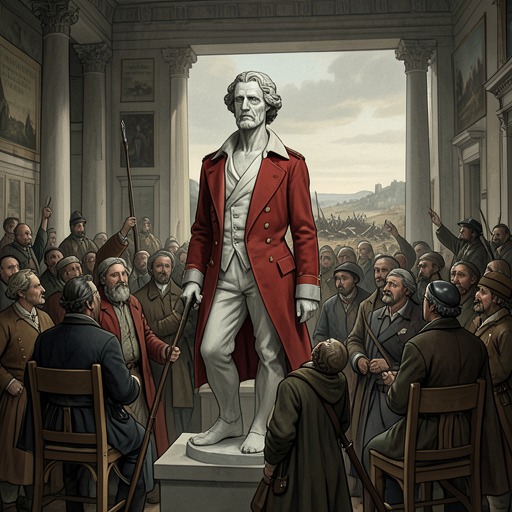
At Thermopylae, the narrator encounters a monument to the stand of three hundred Greeks against a Persian force described as more than one hundred thousand, though some historians estimate a still larger number. The statue of Leonidas and the memorial motto Molon Lave recall a refusal to surrender weapons. The narrator finds the defiance impressive, despite the event having taken place more than two and a half thousand years earlier. This ancient example expands the account’s frame: resistance is remembered not only as the route to independence from Ottoman rule but also as a long-standing national story of facing a much larger power.
An elderly man who arrives at the monument with his wife speaks of resistance as something still present in Greek life. He tells the narrator that his brother lost his life resisting the Germans, connecting family loss to the more recent occupation. The exchange makes the monument a meeting point between an ancient memorial and living recollection: the man looks toward Leonidas while bringing a twentieth-century experience into the conversation. His account does not collapse those histories into one event; it sets them beside each other through the continuing idea of refusal to submit.
The narration then observes that many people regard Greece as suffering oppression by Germany in the present, specifically in an economic sense, and that the will to resist remains strong. This comparison shifts the language of resistance from military occupation to economic pressure, while distinguishing the conditions involved. Across the parade, the flag, the monument, and the elderly witnesses’ stories, resistance becomes a means of interpreting different periods rather than a claim that their circumstances are interchangeable. The national memory is sustained by symbols and repeated acts of telling, but it also remains available for arguments about the pressures of the present.